The Athlete's Guide to Antioxidants: Why Whole Foods Beat the Supplement Aisle
Walk down any supplement aisle and you'll find shelves promising to fight "oxidative stress" and speed your recovery. For endurance athletes — paddlers included — the pitch is tempting: train hard, pop a high-dose antioxidant pill, bounce back faster. But the science tells a more interesting, and more useful, story. For most athletes, the best antioxidant strategy isn't a bottle of vitamin C and E. It's your plate.
Here's what the research actually says, and how to put it to work before your next big day on the water.
First, what antioxidants actually do
When you paddle hard, your muscles burn through oxygen to make energy. A natural by-product of that process is a class of molecules called reactive oxygen species, or ROS — sometimes described as "free radicals." In large, uncontrolled amounts, ROS can damage cells, and that's where antioxidants come in: they help keep ROS in check. It's easy to assume, then, that more antioxidants must be better for a hard-training athlete.
But that assumption misses a crucial detail. The ROS your body produces during exercise aren't purely damaging — they're also a signal. That signal is part of how your body knows to adapt: to build more mitochondria, get better at handling oxygen, and grow stronger. Reviews of the research describe reactive oxygen species and the antioxidant response as central players in training adaptation, not just villains to be eliminated (Clemente-Suárez et al., 2023).
The supplement paradox: why more can be less
This is the part that surprises most athletes. When you flood your system with high doses of isolated antioxidant supplements — think large doses of vitamin C and vitamin E around training — you can actually blunt the very adaptations you're training for. By mopping up the ROS signal too aggressively, high-dose supplements may interfere with the mitochondrial and performance gains that hard sessions are meant to produce.
The International Society of Sports Nutrition's position stand on dietary antioxidants makes this nuance explicit: exercise-induced oxidative stress plays a functional role in adaptation, and routinely taking high-dose antioxidant supplements is not a blanket win for performance — in some cases it can be counterproductive (Gonzalez et al., 2026). In other words, the pill that promises faster recovery might quietly be taxing your progress.
That doesn't mean antioxidants are bad. It means dose and source matter enormously — and that's exactly where whole foods pull ahead.
Why whole foods win
Food delivers antioxidants differently than a megadose capsule. When you eat a bowl of mixed berries, a handful of walnuts, or a plate of colorful vegetables, you're getting antioxidants at nutritional doses, packaged alongside fiber, polyphenols, vitamins, minerals, and other compounds that work together. You get the protective benefits without the sledgehammer effect of isolated high-dose supplements on your training signal.
Broad reviews of micronutrients and athletic performance point in the same direction: adequate micronutrient status supports performance and recovery, and food-first strategies are the foundation, with targeted supplementation reserved for genuine gaps rather than used as a blanket insurance policy (Ghazzawi et al., 2023). For the vast majority of paddlers eating a varied diet, whole foods cover the antioxidant bases beautifully.
There's also a recovery angle. The nutrition science is trending away from thinking only in terms of isolated supplements and toward functional foods — real foods rich in bioactive compounds that support muscle repair, manage post-exercise inflammation, and aid recovery (Wang et al., 2024). A tart cherry, a pomegranate, a serving of leafy greens isn't just "an antioxidant" — it's a whole recovery toolkit in edible form.
What this looks like on a paddler's plate
You don't need to memorize biochemistry. You need color and variety. A simple rule: the more naturally colorful your plate across the week, the broader your antioxidant coverage.
Reach for these regularly:
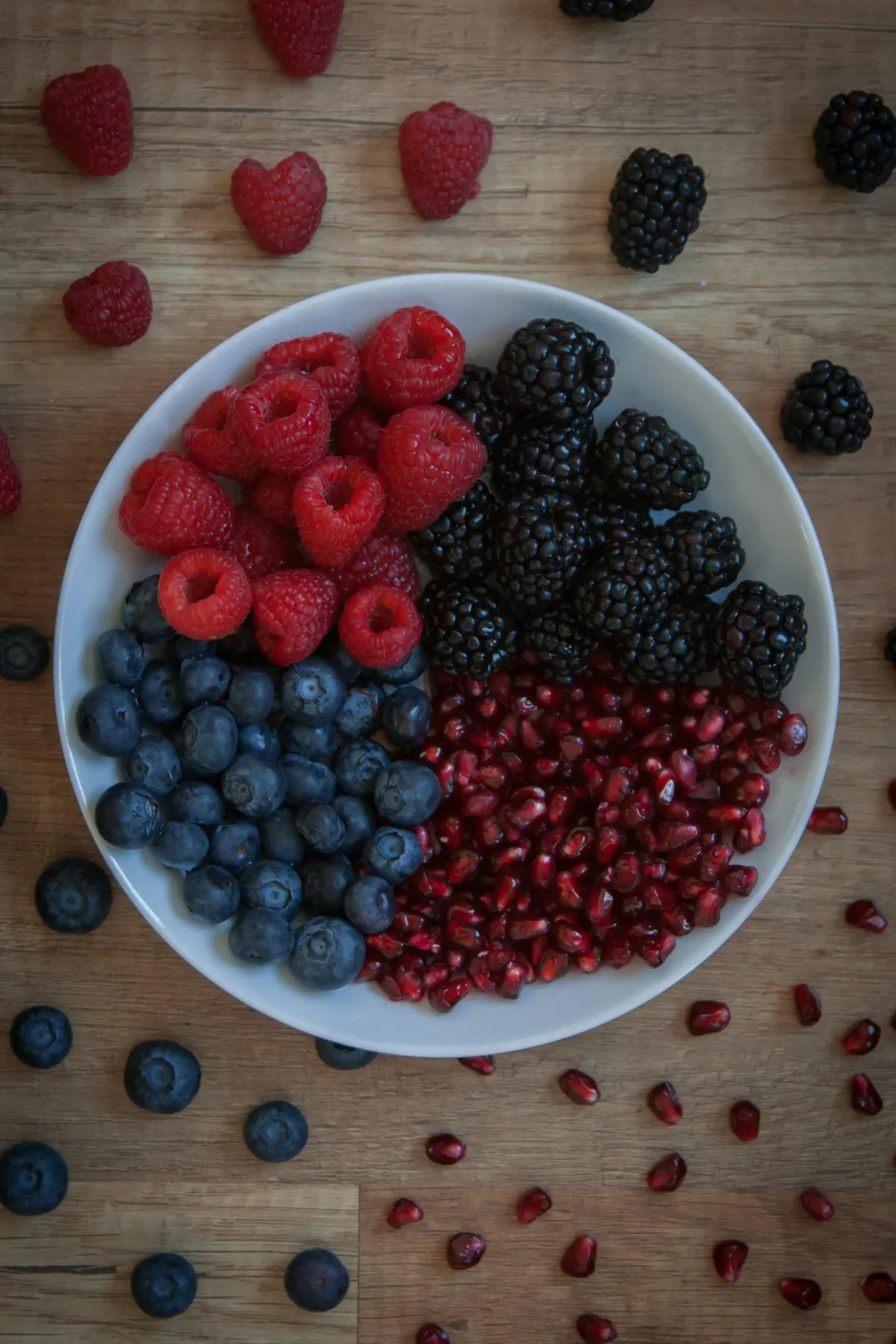
Berries — blueberries, blackberries, raspberries, strawberries. Easy to add to breakfast or a post-paddle smoothie.
Deeply colored vegetables — spinach, kale, beets, red cabbage, bell peppers, broccoli.
Tart cherries and pomegranate — often studied in the context of recovery and soreness.
Nuts and seeds — walnuts, almonds, sunflower seeds for vitamin E in its natural, food-bound form.
Herbs, spices, and extras — turmeric, ginger, green tea, dark chocolate, and extra-virgin olive oil all bring antioxidant compounds along for the ride.
The goal isn't perfection at any single meal. It's a steady, varied intake across your training week — most of it coming from food you'd want to eat anyway.
So should you ever supplement?
Sometimes, yes — but strategically, not by default. Supplements make sense to correct a diagnosed deficiency (iron and vitamin D are common ones for athletes), to fill a genuine dietary gap, or in specific short-term scenarios guided by a professional. What the evidence discourages is the reflexive habit of taking high-dose antioxidant pills every day to "recover faster," because that's the pattern most likely to blunt your adaptations (Gonzalez et al., 2026). If you're considering a supplement, that's a great conversation to have with a qualified coach or dietitian who can look at your individual situation.
The bottom line for paddlers
The oxidative stress of a hard paddle isn't something to fear or immediately extinguish — it's part of how you get fitter. Your job is to support recovery without switching off the adaptation signal, and the cleanest way to do that is food first: a colorful, varied, whole-food diet that delivers antioxidants at the doses your body evolved to use. Save the supplement aisle for real, specific gaps. Fill your plate for everything else.
Want antioxidant-rich eating made simple for paddlers? Explore the Nutrition pillar — and grab the antioxidant-rich meal plan and recipe bundle to put this into practice this week.
Evidence-informed guidance, not a substitute for individual medical or dietitian advice. If you have a medical condition or specific dietary needs, work with a qualified professional.
References
Clemente-Suárez, V. J., Bustamante-Sanchez, Á., Mielgo-Ayuso, J., Martínez-Guardado, I., Martín-Rodríguez, A., & Tornero-Aguilera, J. F. (2023). Antioxidants and sports performance. Nutrients, 15(10), Article 2371. https://doi.org/10.3390/nu15102371
Ghazzawi, H. A., Hussain, M. A., Raziq, K. M., Alsendi, K. K., Alaamer, R. O., Jaradat, M., Alobaidi, S., AlAqili, R., Trabelsi, K., & Jahrami, H. (2023). Exploring the relationship between micronutrients and athletic performance: A comprehensive scientific systematic review of the literature in sports medicine. Sports, 11(6), Article 109. https://doi.org/10.3390/sports11060109
Gonzalez, D. E., Dickerson, B. L., Roberts, B. M., Kurtz, J. A., Waldman, H. S., Gonzalez, A. M., McAllister, M. J., Heileson, J. L., Bloomer, R. J., Arent, S. M., Candow, D. G., Stout, J. R., Hecht, K. A., Campbell, B., Kerksick, C. M., Kalman, D., Antonio, J., & Kreider, R. B. (2026). International Society of Sports Nutrition position stand: Effects of dietary antioxidants on exercise and sports performance. Journal of the International Society of Sports Nutrition, 23(1). https://doi.org/10.1080/15502783.2026.2629828
Wang, L., Meng, Q., & Su, C.-H. (2024). From food supplements to functional foods: Emerging perspectives on post-exercise recovery nutrition. Nutrients, 16(23), Article 4081. https://doi.org/10.3390/nu16234081