GLP-1 Medications: The Side Effects Paddlers Need to Know, and How to Protect Yourself
More paddlers are asking me about GLP-1 medications such as semaglutide (Ozempic, Wegovy), tirzepatide (Mounjaro, Zepbound), and liraglutide (Saxenda). They work. People lose weight, often a lot. But the scale only tells you how much you lost, not what you lost, and that is where my concern as a coach begins.
This post covers the side effects you need to know about, short-term and long-term, and the specific things you can do to protect your body while you take these medications. I am not here to tell you whether to take one. That decision belongs to you and your prescriber. I am here to make sure you go in with your eyes open and your muscles protected.
A note on the evidence: I searched for studies of GLP-1 medications in paddlers, rowers, or any athletes, and found none. Everything below comes from studies of adults with overweight or obesity, so I label it Transferred. Where I offer my own coaching experience with no study behind it, I label it Coach's Wisdom.
Short-term side effects: your gut and your fuel
The most common side effects are digestive, and they're common. In one large liraglutide trial reviewed by de Paulo et al. (2026), 40.2% of people on the drug reported nausea, compared with 14.7% on placebo. Diarrhea (20.9% vs 9.3%), constipation (20% vs 8.7%) and vomiting (16.3% vs 4.1%) followed the same pattern. The same review found that higher doses increased these problems, and that lifestyle changes alone may not be enough to resolve them. Transferred
The quieter problem is how little people end up eating. Ampofo et al. (2026) pooled 19 trials and found daily energy intake fell by 24% to 39%. Few of those trials ever checked for nutrient deficiencies. When the authors looked at a lab marker of protein and energy status, low readings appeared in 2.90% of people on the drug, compared with 1.77% on placebo. We never screened vitamin D, B12, and folate systematically, so we don't know how common those deficiencies are. Transferred
For a paddler, that combination matters. Nausea and a small appetite make it hard to fuel a long session. Vomiting or diarrhea on a hot day on the water is a fast route to dehydration. Coach's Wisdom
The long-term cost: muscle
When you lose weight, you never lose only fat. GLP-1 medications are no exception. Laverde et al. (2026) pooled seven placebo-controlled trials and found people on these drugs lost about 3.8 lb more lean mass than people on placebo. In a smaller analysis, Woźniak et al. (2026) found lean mass fell by about 1.7 lb while fat fell by about 7.6 lb. Fat is still most of what goes, which is good news. Transferred
How much of the loss is lean tissue depends on the drug. Laverde et al. (2026) report that lean mass made up 14% to 22% of total weight lost with liraglutide, about 26% with tirzepatide, and up to 45% with semaglutide. Lean mass is not the same as muscle, since it also includes water and organs. But muscle is part of it. Transferred
Here is the gap that worries me most. None of the trials in these reviews measured strength or physical function, and most enrolled people were in their 30s to 50s. Many of you are in your 50s, 60s and 70s, an age when muscle is harder to build back. Bone is another unknown. Ampofo et al. (2026) note that none of the 19 trials they reviewed measured bone density, which matters for every postmenopausal woman in our community. Transferred
In the boat, muscle is your engine. It drives rotation, holds your posture through the catch, and protects your shoulders and back when you are tired. Losing it means losing power and stability, and it raises your injury risk. Coach's Wisdom
What happens when you stop
Many people stop these medications because of cost, side effects, or supply. West et al. (2026) reviewed 37 studies of people who stopped weight-management drugs. After semaglutide or tirzepatide, people regained about 1.8 lb a month, roughly 22 lb in the first year. On average, they were projected to return to their starting weight about a year and a half after stopping. Blood pressure, blood sugar, and cholesterol improvements also faded within about 1.4 years. Transferred
Two more findings stand out. Weight came back faster after the drugs than after a diet-and-exercise program, even when people had lost the same amount. And extra behavioral support after stopping did not slow the regain. Transferred
Put that next to the muscle findings, and you see the real risk. Unless you deliberately protect your muscle, you can lose muscle on the way down and regain mostly fat on the way back up. That is why what you do while you are on the medication matters so much. Coach's Wisdom
How to protect yourself
The best evidence points to one thing: move and train for strength. Vandoni et al. (2026) compared the drug alone, exercise alone, and the two together across nine trials. The combination produced the greatest fat loss. In one included trial, people who exercised while on liraglutide improved their physical function and fitness, while those on the drug alone did not. To be honest about the limits, that review could not analyze lean mass, and no trial has yet tested resistance training on its own during GLP-1 treatment. Transferred
Until that research arrives, here is how I coach paddlers on these medications. Coach's Wisdom
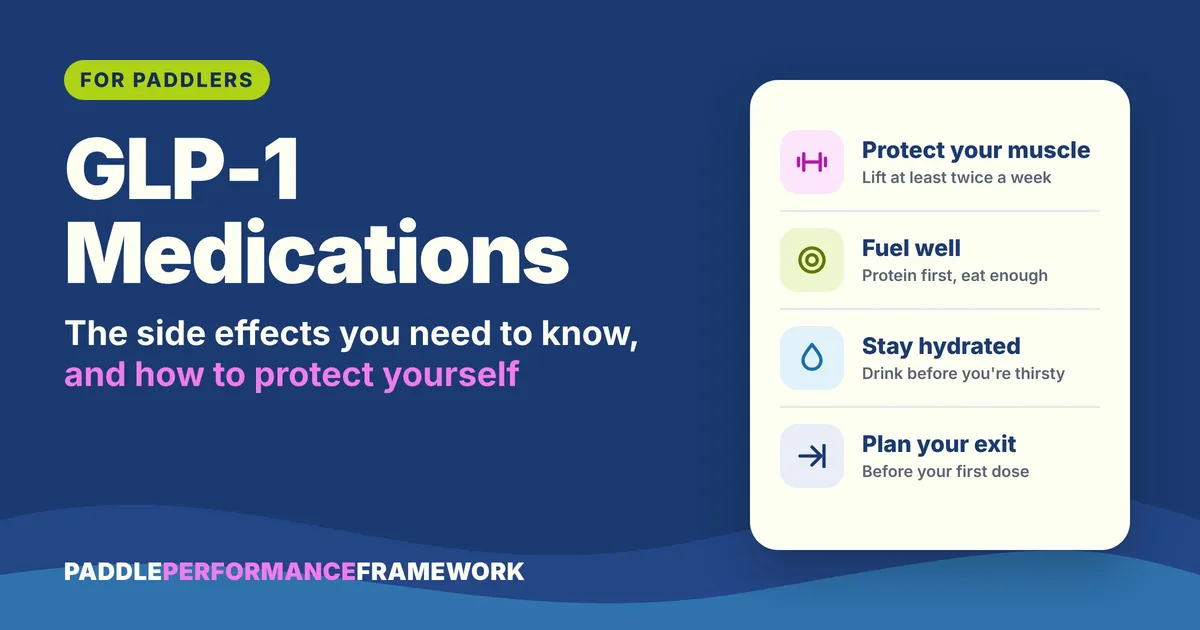
Lift, at least twice a week. Train your legs, hips, back, chest, and shoulders. Muscle your body uses is muscle your body fights to keep.
Put protein first at every meal. When your appetite is small, eat the protein on your plate before anything else.
Eat enough, even when you are not hungry. Small, frequent meals are easier on a queasy stomach than three large ones.
Drink before you are thirsty. Drink extra water, especially if you have had vomiting or diarrhea.
Ask for blood work. Ask your prescriber to check vitamin D, B12, iron, and folate, since the trials rarely did.
Plan your exit before you start. Decide with your prescriber how you will stop, and keep strength training well beyond your last dose.
What this means to you
Coach: If a paddler on your team starts a GLP-1, add two strength sessions a week and watch for fatigue, light-headedness or a drop in power.
Paddler: Your goal is to lose fat, not muscle. Lift twice a week, eat protein first, and drink before you are thirsty.
The bottom line
GLP-1 medications can be a useful tool, but they are not a free pass. Expect your gut to complain, especially early and at higher doses. Expect to eat far less than you need unless you plan for it. Most of all, expect to lose some muscle unless you work to keep it, and expect the weight to return if you stop without a plan.
The paddlers who do well treat medication as one part of a bigger plan: strength, mobility, real food, and steady time on the water. If you want help building that plan, start with my 28-Day Mobility Challenge and the Paddling Community.
This post is general education, not medical advice. If you take or are considering a GLP-1 medication, talk with your prescriber or a registered dietitian before you change your training or eating, and tell them right away about severe stomach pain, ongoing vomiting, or signs of dehydration.
References
Ampofo, E., Apprey, C., Amoako, M., & Turkson, F. D. (2026). A systematic review and meta-analysis of malnutrition and metabolic failure in high-potency incretin therapy. Obesity Science & Practice, 12(5), e70188. https://doi.org/10.1002/osp4.70188
de Paulo, R. S., Bonifácio, D. B., de Carvalho, M. H. L., & Bressan, J. (2026). Dietary strategies and nutritional management in patients receiving GLP-1 and dual GIP/GLP-1 receptor agonists as adjuncts to lifestyle interventions: A systematic review of randomized clinical trials. Diabetes, Obesity and Metabolism, 28(7), 5492–5507. https://doi.org/10.1111/dom.70779
Laverde, L. P., Muñoz-Velandia, O. M., Alfonso, D., & Gómez Medina, A. M. (2026). Effect of GLP-1 receptor agonists at doses for obesity management on muscle health: Systematic review and meta-analysis of randomized controlled trials (RCTs). International Journal of Obesity, 50(8), 1638–1646. https://doi.org/10.1038/s41366-026-02118-y
Vandoni, M., Gatti, A., Rossi, V., Giuriato, M., Carnevale Pellino, V., Zuccotti, G., & Calcaterra, V. (2026). Comparative efficacy of GLP-1 receptor agonists, exercise, and their combination on body composition and glucolipid metabolism in adults with overweight or obesity: A network meta-analysis of randomized controlled trials. Obesity Reviews, Article e70189. Advance online publication. https://doi.org/10.1111/obr.70189
West, S., Scragg, J., Aveyard, P., Oke, J. L., Willis, L., Haffner, S. J. P., Knight, H., Wang, D., Morrow, S., Heath, L., Jebb, S. A., & Koutoukidis, D. A. (2026). Weight regain after cessation of medication for weight management: Systematic review and meta-analysis. BMJ, 392, e085304. https://doi.org/10.1136/bmj-2025-085304
Woźniak, M., Tarcz, Z., Pyczek, G., Bogacka, J., Diniejko, A., Kuryłowicz, A., Mamcarz, A., & Śliż, D. (2026). The impact of glucagon-like peptide-1 (GLP-1) receptor agonists on body composition in individuals with overweight and obesity: A systematic review and meta-analysis. Journal of Clinical Medicine, 15(17), 6818. https://doi.org/10.3390/jcm15176818
About these sources
I read all six reviews in full. All are 2026 publications. Five of the six report no pharmaceutical-company funding for the review itself. However, the trials they pooled were largely sponsored by drug manufacturers, and Ampofo et al. (2026) state this directly. None of the reviews name the countries of their trials, so I cannot flag United States data. I found no GLP-1 studies in paddlers or any other athletes.